|
Anish Kapoor makes the invisible visible
and challenges our perception
For more than five decades, Anish Kapoor has shaped contemporary art with an unmistakable language that lends his sculptures a universal appeal. Through his use of loose pigments, Kapoor blurred the boundaries between sculpture and painting, creating works that appear both tangible and ephemeral. Anish Kapoor’s work captivates using opposites: exterior and interior, dark and light, material and immaterial, body and soul. He was awarded The Wilhelm Lehmbruck Prize in 2025 for his pioneering work, which is now honoured with a comprehensive exhibition, featuring 16 works spanning five decades of his artistic practice. A must see for every lover of sculpture.
Etienne Boileau
Since the late 1980s, Kapoor began to explore the interplay between interior and exterior, as well as emptiness and fullness, in an enormous variety of materials such as: stone, stainless steel, resin, pigments, wax, lacquer, metal, wood, fiberglass, alabaster and onyx. His highly polished mirror sculptures are renowned worldwide. During the exhibition in the Lehmbruck Museum you will find one big mirror installation that covers a complete hall. It is the Double S-Curve from 2019, which reflects and transforms the bodies of visitors and the surrounding objects on the wall in a spectacular way.
Illusionist series of paper works
Kapoor’s objects distort the surroundings, challenge perception and dissolve the boundaries of physical space, which is clearly highlighted in this overview. The exhibition also includes an extensive collection of drawings and gouaches in which colour, physicality and darkness converge. There is a series of paper works Non-Object Black on display, whose jet-black pigments (Vantablack) draw the eye in. Anish Kapoor is a master in creating situations in which our trust in our own perception is put to the test. Familiar ways of looking fall away, and within that void, space is created for new experiences and ways of seeing. The concept of ‘The Void’ is central to Kapoor’s thinking and takes many forms in his work. A perfect example of this kind of work is Descent into Limbo 1992, that consists of a black circle, approximately sixty centimetres in diameter, situated in the centre of the floor of a cabinet in Museum De Pont in Tilburg, the Netherlands. At first glance, it appears to be a flat surface, but on closer inspection it turns out to be a hollow. The interior is covered with dark blue pigment that absorbs all light, causing any sense of perspective to disappear.
How can we represent what is intangible, invisible – that constitutes the very essence of humanity?
The embodiment of womanhood
With this exhibition, Kapoor’s fascinating works fit very well in the museum building’s architecture with a lot of steel and glass and some open spaces. As we walk through the exhibition, we encounter works that refer to other than earthly dimensions – sometimes mysterious, ambiguous or slightly provocative. Take for example the work Mother as a mountain, which is completely made from pigments. In this work the link between the material and the immaterial is at stake. According to Söke Dinkla, one of the essayists that contributed to the exhibition catalogue: ‘In abstract terms one is reminded of the shape of a vulva that opens into the interior of a body’. According to Arne Groh ‘Kapoor, another essayist, Kapoor uses the shape and title of this work to trigger associations of fertility, life, origin, protection, corporeality and transience. In many spiritual traditions the mountain is considered as the embodiment of womanhood and the mother of the world who protects and nourishes us.’
Fundamental conditions of human existence
With an infinite variety of forms, Anish Kapoor explores the fundamental conditions of human existence. His work is about the mystery of life and death, about the conflicting forces that shape our existence. In an interview in 2022 that Kapoor had with Ai Weiwei in the programme Studio B, on the Al Jazeera channel Kapoor stated: “I have been drawn into primal sacrifice; death and its origin has to do with some ritualistic original practice. I have been working with that over the last 40 years. Of course, some things are consistent: the colour red, the idea that the two-dimensional world and the three dimensional are mixed with each other. This is my voyage of discovery. “
‘What I am trying to do is to make a picture of the interior, the interior of me.’
Past, Present, Future
Kapoor’s sculptures are no static objects, they are experimental spaces that move, astonish and transform. In the exhibition at the Lehmbruck Museum, visitors will encounter on a small mezzanine the monumental work Past, Present, Future. A 9 metres high hemisphere, made of highly pigmented red appears to grow out of the surrounding architecture. Its shape is kept in constant motion by a heavy metal form that slowly pushes the material from the right to the left, squeezes it up against the wall, draws it back on its return and drags it along. The material brings up associations with blood and the inside of a body. This visceral quality is a thread through Kapoor’s oeuvre, which can be highly appreciated and fully understood because of his frequent use of the colour red. For this astonishing object on the mezzanine Kapoor used steel and wax, while referring to the process of life: birth, metamorphosis, disintegration, and regeneration.
Close to the entrance of the museum hall you ‘ll find an immense corridor of three huge open forms, made completely out of resin, titled 1st body 2013, highlighting our physical and material connection to the earth. To me it felt as a rather rough and overwhelming installation, that I couldn’t really get grips on. In another open space hall of the Lehmbruck Museum lie four large sculptures cut from pink onyx. The physicality of the works is clear, and the oval openings, incisions and cavities cut into the stone are typical for Kapoor’s work. They suggest body orifices, and remind us of the void, a recurrent theme of Kapoor. To me, these works of pink onyx occurred to be primarily aesthetic. The deeper layer and the refence to body orifices occurred to me only later.
Do not close down that part of yourself that might risk taking part in something somebody else will find controversial’
Poetic or political art?
As Ai Weiwei asked Kapoor in the same interview on the Al Jazeera Channel whether his work is somehow political, Kapoor answered: “People in culture need to have a political voice, but my art isn’t overtly political in any obvious way, but I hope it is in all sorts of underhand ways. We live in a post knowledge era. My job as an artist is to de-educate myself and find a way to something that I haven’t the faintest idea what it is. But poetic and visual culture matter to governments. They are afraid of what artists think and how they put it in the world. The poetic act has such a power that it can drive hundreds of thousands of people to certain kind of conclusions about the state of being hat we occupy. Art can be political but also philosophical, in what is not said or what is half said. Freedom of expression is not tolerated in many parts of the world nowadays. Our greatest fear has to be self-censorship. Self-censorship says: ‘Close down that part of yourself that might risk taking part in something somebody else will find controversial.’”
Anish Kapoor. Winner of the Wilhelm Lehmbruck Prize of the City of Duisburg and the Rhineland Regional Council
Lehmbruck Museum, Duisburg
24 April – 18 Oktober 2026
www.lehmbruckmuseum.de
A catalogue has recently been published, titled ‘Anish Kapoor’
Buchandlung Walther König, Cologne
|

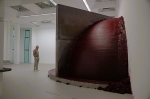 Anish Kapoor, Past, Present, Future, 2006, Foto Gerrit Jan Hoogland